Draw a subway line straight from downtown Los Angeles to the beach in Subway Builder, and the game will not stop a player. It will simply let that line sit there, empty, while the ridership numbers refuse to climb, because that is what would happen on the actual streets of Los Angeles.
That failure is not a glitch. It is the entire point of Subway Builder, a hyperrealistic transit simulation from Borough Studio launching on Steam July 17, 2026. Every instinct a player has built up from years of SimCity, Cities: Skylines, or any other builder tells them to connect the two biggest landmarks on the map with the cleanest possible line. In most of those games, that instinct gets rewarded. In Subway Builder, it gets exposed. The game does not care how satisfying a route looks. It cares whether real commuters, modeled from real data, would actually board that train.
The Math Behind the Map

Subway Builder runs on U.S. Census Bureau and employment data layered with a gravity model, the same kind of framework urban planners use to predict how likely people are to travel between two points based on distance and demand. Add in real geographic constraints like tunnels, viaducts, existing building foundations, and street grids, and the game stops simulating a generic city. It starts simulating the specific, stubborn facts of Los Angeles, Boston, or Newcastle. Reports vary on exactly how many cities are playable at launch, with figures ranging from roughly two dozen to more than 30 real U.S. and U.K. cities, according to the game’s official rollout coverage on GamesPress, and each one reportedly carries its own commuter patterns, its own terrain headaches, its own reasons a “good-looking” line quietly fails.
This is worth sitting with for a second, because it flips the usual builder-genre contract on its head. A player who has spent hundreds of hours drawing highways in Cities: Skylines has been trained to believe that if a route connects two dense areas, ridership will follow. Subway Builder’s census-driven passenger model does not grade on effort or aesthetics. It grades on whether the demographic data supports the trip. A line can look like a masterpiece and still run near-empty trains, because the people who would need it live somewhere else entirely.
A Genre That Usually Sells Realism as Mood Lighting

Transit and train sims have leaned on the word “realistic” for decades, but it has mostly meant something closer to atmosphere. Transport Tycoon, one of the genre’s founding titles according to its entry on Wikipedia, built its appeal around running a profitable transport company, moving people and goods efficiently. Simutrans carried that torch forward as an open-source transport simulator, as described on its official site, still centered on routes and profitability rather than freeform art. Train simulator titles broadly aim for what European Studios describes as “technical accuracy, strategic gameplay, and immersive environments” in its breakdown of the genre, but that accuracy usually lives in the cab view and the sound design, not in whether the route itself makes economic sense against real population data.
Subway Builder borrows that authenticity-obsessed lineage and points it somewhere sharper. The realism is not paint. It is the referee. A player can still route however looks satisfying, but the game’s ridership model, not the player’s eye, decides whether that route survives contact with reality.
One Developer, One Very Unglamorous Obsession

Behind the simulation is Colin Miller, described in MSN’s coverage of the game and elsewhere as the solo indie developer driving Subway Builder’s design, even as Steam’s credits list a wider team helping bring it to launch. That detail matters less as trivia and more as a signal of where the ambition actually sits. Building dozens of cities with individually accurate demographic layers is not a flashy technical flex the way ray tracing or open-world scale might be. It is the opposite: unglamorous, back-end math, the kind of work that shows up nowhere in a trailer but everywhere in whether a line succeeds or fails.
Consider a hypothetical familiar to anyone who has looked at a real ridership heat map: the busiest bus corridor in a mid-sized city is rarely the one connecting downtown to the airport, the route everyone assumes will win, but instead a scrappy line through working-class neighborhoods that never show up on postcards. That kind of counterintuitive pattern is the same lesson Subway Builder’s design seems built around: the obvious route and the correct route are frequently not the same line at all.
The Price of the Truth
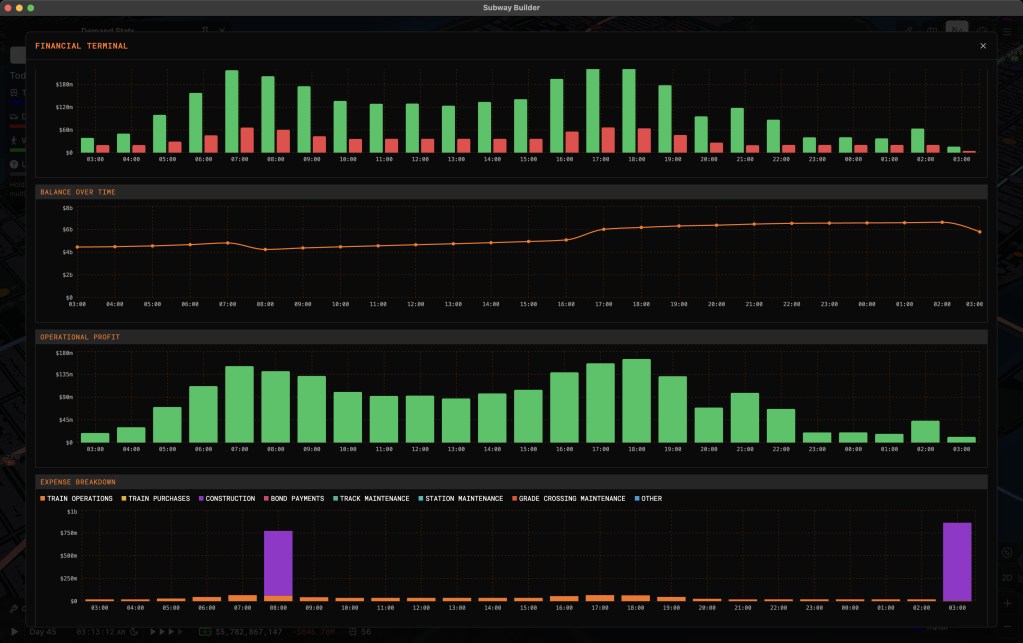
Subway Builder has reportedly become its own small flashpoint over pricing, with BigGo’s coverage framing the debate as a question of whether the game’s ambitions justify its cost. The more interesting read is that the pricing argument is really the realism argument, just measured in dollars instead of ridership numbers. Most builder games pad their value with unlimited budgets, cosmetic customization, and routes that reward players for things looking cool. Subway Builder offers none of that cushioning. No infinite money to bail out a bad decision. No credit for a line that merely photographs well. The sticker shock, in other words, may be less about the number on the price tag and more about being asked to take a simulation seriously instead of playing with it.
Players Are Recalibrating in Real Time
Fast Company called it “like SimCity but for transit nerds” in its feature on the game, a tidy label that undersells how differently the two games actually behave under the hood. SimCity fails players through zoning mismatches and budget shortfalls that players can see coming a mile away. Subway Builder fails players through geography and demand, the same forces that quietly determine whether a real transit authority’s new line becomes a success story or a punchline. YouTube creators have picked up on this shift, with one video titled “This Realistic Transit Sim Actually Challenges You!” and another calling it a surprise in “This Realistic Subway Building Game Surprised Me!” Both point to the same discovery: this is a builder that can say no, and it says no using the same logic a city planner would.
A Reddit post announcing the launch, later highlighted in r/pcgaming, quoted the game’s own description almost word for word: a hyperrealistic transit simulation built around commuters derived from census data. It reads like marketing copy until a player actually tries to force a line through downtown Los Angeles and watches the ridership numbers refuse to cooperate.
The subway builder genre has always sold the fantasy of effortless infrastructure, a clean line here, a shiny station there, ridership assumed rather than earned. Subway Builder’s real contribution may be refusing to hand that fantasy over. Players do not need permission to draw a bad line. They need a game willing to show them, with real census numbers and real geography, exactly why that line was never going anywhere. Would the genre be better off if more builders forced players to answer to the numbers instead of the map’s blank canvas?
F.A.Q.
When does Subway Builder come out?
Subway Builder is set to release on July 17, 2026, on Steam, as confirmed by its official store page. This hyperrealistic transit simulation game is developed by Borough Studio and features a launch discount of 25% during the first two weeks.
What type of game is Subway Builder?
Subway Builder is a hyperrealistic transit simulation game. Players design, construct, and optimize subway systems using authentic demographic, geographic, and transportation data. The game emphasizes real-world constraints and costs, requiring strategic planning to succeed.
How much does Subway Builder cost?
Subway Builder is priced at $29.99 on Steam. However, there is a 25% discount available during the first two weeks after the game’s release on July 17, 2026, making it a more affordable option for early buyers.
Is Subway Builder free?
No, Subway Builder is not a free game. It is available for purchase on Steam, with a regular price of $29.99. A launch discount is available, offering a 25% reduction for a limited time after its release.
Does Subway Builder have mods?
Currently, there is no official mention of mod support for Subway Builder on its Steam page or related announcements. The game focuses on providing a hyperrealistic transit simulation experience based on real-world data.
What platforms is Subway Builder on?
Subway Builder is available exclusively on PC via Steam. As of the information provided, there are no confirmed plans for release on other platforms such as consoles. The game supports single-player mode with Steam Achievements and Cloud features.
Is Subway Builder worth it?
Subway Builder offers a unique and realistic approach to transit simulation, focusing on real-world data and constraints. It challenges players to build efficient subway systems, making it a compelling choice for fans of strategy and simulation games. Consider its features and price before purchasing.
BFG drafts articles with AI from our team’s own research, takes, and opinions — every piece is reviewed and edited by our staff.